Why One Small Detail Can Cost You Clients

In 1969, a psychologist named Philip Zimbardo ran an unusual experiment. He abandoned two identical cars in two different locations: one in the Bronx in New York City, and one on a quiet street in Palo Alto, California.
The Bronx car was stripped within 24 hours. Tyres gone, radio ripped out, windows smashed. Passersby joined in without hesitation.
The Palo Alto car sat untouched for over a week.
Then Zimbardo walked up to it with a sledgehammer and smashed one window himself.
Within hours, the Palo Alto car was destroyed just like the Bronx one.
One broken window changed everything.
In 1982, criminologists James Q. Wilson and George L. Kelling wrote about what Zimbardo’s experiment revealed. They called it the Broken Windows Theory: visible signs of disorder signal that nobody is watching, nobody cares, and further disorder is acceptable. One broken window invites the next.
Your business has broken windows
You might think this is about cars and crime. It isn’t. It’s about signals.
When someone lands on your website, they read dozens of tiny signals in seconds. Not consciously. Their brain is scanning: Does this look like a business that cares? Or like a business that’s given up?
- A website last updated in 2019 says: “We’re probably behind in other areas too.”
- A logo that looks different on the website than on the invoice says: “We don’t sweat the details.”
- A contact form that goes unanswered for three days says: “Attentiveness isn’t our thing.”
None of these kill you outright. But they compound. And together, they tell a story you didn’t mean to tell.
One broken window invites the next
Here’s the psychological part. It’s not just that clients notice the broken window. It’s that one broken window makes every other flaw more visible. The outdated website makes the slow reply feel like a pattern. The mismatched branding makes the typo in the proposal feel deliberate.
Clients don’t see individual mistakes. They see a picture.
The reverse is also true
A fast, professional website doesn’t just look good. It raises the baseline expectation. When your site is clean and well-made, clients assume your work will be too. That assumption does work for you before you’ve even spoken.
It’s the same car in Palo Alto before anyone touched it: people walked past and assumed someone was taking care of it.
Where to start
You don’t need to fix everything at once. Start with the most visible window.
For most businesses, that’s the website. It’s the first thing a new client sees, often before they’ve heard your name spoken. A professional website signals that you’re serious about your business, and that you’ll be serious about theirs.
One fix. One window. The rest follows.
If your website is showing its age, get in touch. We’ll build something that works for your business around the clock.
Related Posts
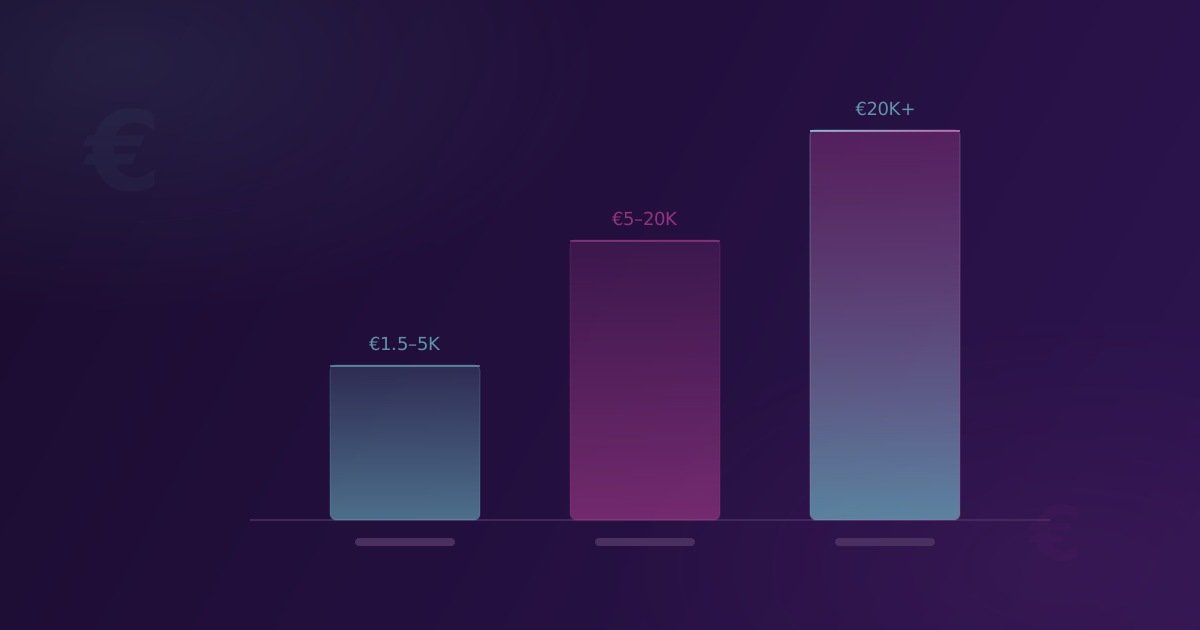
How Much Does a Web Application Cost in 2026?
Real price ranges for websites and web applications in 2026, from simple business sites to complex platforms. No hidden costs, no vague answers.

Custom Website vs. Template
Template websites seem cheap, but hidden costs add up fast. Learn why custom website development is a smarter investment for your business.